


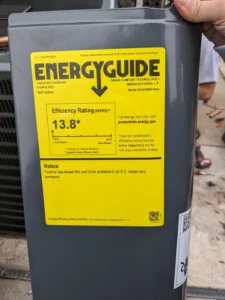
It’s the age-old question that heats up every spring and summer. Do we crank up the thermostat and stink up like a swamp? Or do we suffer in the summer heat so we don’t run up our energy bills? Cooling season energy bills are a common and major cause of household anger, and it can be hard to know where to start when it comes to finding the source of the problem. But what if the root cause of your higher bills is your air conditioner?
If you find yourself asking “how to reduce energy bills” every summer and just trying to survive the heat, one culprit you might be missing could be stealthily driving up your utility costs month after month, and you don’t even know it. The SEER rating of your AC or heat pump is a major factor in energy savings.
Running a unit with the wrong SEER rating for your home and local climate and cooling needs will cause a system to use more energy, cause inconsistent cooling, and cost you more money overall. Learning how SEER ratings work and what your system is rated at can help you determine when a unit is costing you more than it needs to.
What does SEER Rating mean?
SEER stands for Seasonal Energy Efficiency Ratio. This rating is a way of measuring the cooling power of an air conditioner or heat pump throughout an entire cooling season. The higher the SEER rating, the better. A higher SEER number means your cooling system is more energy efficient.
In plain English, that means higher SEER numbers equal more cooling and less electricity. A lower SEER rating will require more energy to keep your home cool and comfortable.
Why The Wrong SEER Rating Causes High Energy Bills
Air conditioners and heat pumps are not all made the same and will not all be equal when it comes to your home and cooling needs. The wrong size or an older model might mean your AC or heat pump has a SEER rating that isn’t compatible with your home, how you live in it, and the local climate. When that happens, you’ll be overspending on energy bills instead of saving money.
Humid summers and high temperature swings in Burton, Wickliffe, Lodi, Strongsville, and the rest of our Northeast Ohio area mean homes need a SEER rating that can accommodate the demands of local weather. If your unit has an older or lower SEER rating than is recommended, the system may have to cycle on and off for longer periods of time. Not only is that inefficient and not cost-effective, but it will also not improve your home comfort.
Need Services?
We Can Help!
Why an Improper SEER Rating Can Lead to Increased Costs
Increased run times
Systems with a lower SEER rating must work harder and longer to cool your home to the set temperature, especially if your local area experiences a heat wave. This additional running time directly results in greater electricity consumption.
Humidity
Systems with an incorrect SEER rating for the region may not remove humidity efficiently. If your air indoors feels damp or sticky, you may be tempted to lower the thermostat and push the unit to use even more electricity.
Cooling
Cooling may be uneven, with certain rooms cooler or warmer than others. This makes your system cycle more frequently, leading to energy waste.
Maintenance
Systems that are overworked are more likely to sustain mechanical stress, leading to a higher risk of breakdowns and costly repairs.
Old AC Systems Are the Most Common Culprit
Older air conditioners and heat pumps that were installed years ago have a tendency to have SEER ratings much lower than modern efficiency standards. While older systems will likely still work, they do not operate as efficiently as modern-day systems.
Many homeowners are shocked to learn their rising energy bills are not a result of a change in usage but rather due to an aging unit no longer meeting the needs of their home.
Higher SEER Ratings Are Not Necessarily Better
In general, a higher SEER rating is better. Bigger is not always better, though. Installing a unit that is too large for your home without considering the proper design can lead to short cycling and reduced cooling performance.
If the SEER is too high for your home, it will not have the desired impact. Things such as the size of the system, the state of ductwork, insulation, and the layout of your home all factor into whether a higher SEER rating can provide actual savings. The ideal SEER rating for your home should balance efficiency, comfort, and long-term reliability.
Determining the Right Time to Get Your SEER Rating Checked
SEER ratings need to be assessed if you experience the following:
- Increasing energy bills during the summer
- Long cooling cycles or short cycling
- Temperatures in different rooms vary a lot
- Your AC or heat pump is more than 10 or 15 years old
These are signs that your system is no longer efficient for your home.
Need Services?
We Can Help!
Let Blind & Sons Help You with Your SEER Rating
Blind & Sons offers expert HVAC evaluations in Northeast Ohio. Our technicians can assess your current system, the layout of your home and your comfort needs to determine whether your system has the right SEER rating.
If a replacement is necessary, we guide homeowners in choosing systems that can give real energy savings without pushing them into units with an unnecessarily high upfront cost. We don’t just recommend the highest SEER rating available, though. The right SEER rating is the one that is best for your home.
Whether you are in Uniontown, Waynesburg, Solon, or surrounding communities, correcting an inefficient SEER rating can save you money on energy bills, make your home more comfortable, and even prolong the life of your system.
SEER Rating FAQ
What is a SEER rating?
A SEER rating measures how efficiently an air conditioner or heat pump cools your home over a full cooling season.
Can a wrong SEER rating increase energy bills?
Yes. An improper or mismatched SEER rating can cause a system to run longer and use more electricity, driving up monthly energy costs.
Is a higher SEER rating always better?
Not always. The right SEER rating for your home depends on the size of your home, local climate, ductwork, insulation and your typical usage patterns. Oversized units can reduce efficiency.
How do I find out what my SEER rating is?
Your SEER rating should be listed on the data plate on your system or in the manufacturer’s information. A professional inspection can help verify this.
When should I replace my AC or heat pump for a better SEER rating?
If your unit is more than 10 to 15 years old and energy bills are climbing, then replacement with a new properly rated SEER system may be worth the investment.
You’re an MVP!
Maintenance Value Plan Program
At Blind & Sons, MVP stands for Maintenance Value Plan. Join now for discounts, loyalty reward dollars, special service offers and peace of mind. Learn more about the benefits of signing up!
- Discounts
- Loyalty reward dollars
- Special service offers
- Peace of mind